
Pickles Are Done. Jarring Has Begun.
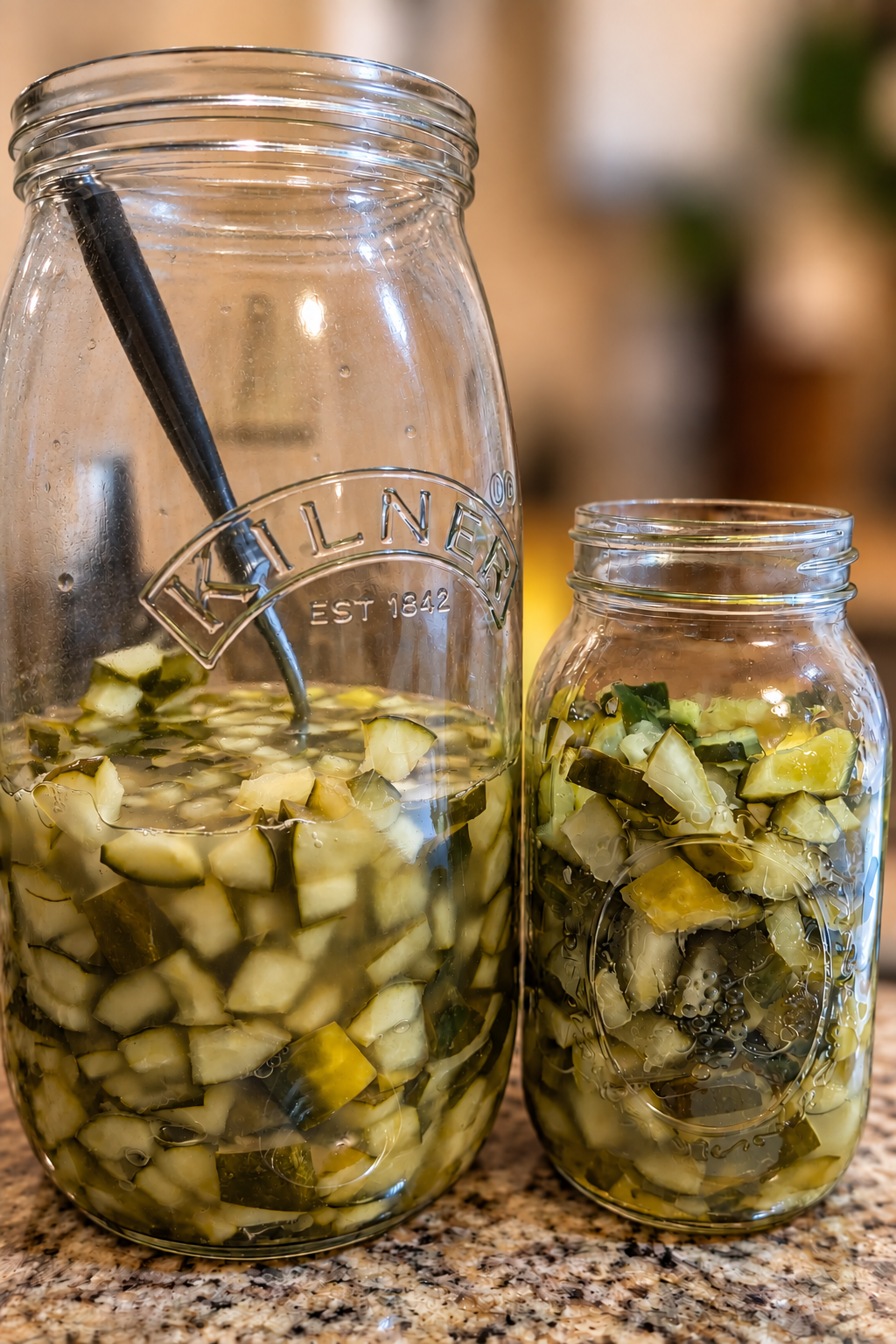
Yes, these are my actual pickles.
I’ve been making fermented pickles lately, and I’m almost embarrassed to call this a recipe.
It’s ridiculously easy.
About 15 minutes of actual work. Then you set the jar on the counter, leave it alone for five days, and let fermentation do the rest.
I originally started doing this because I wanted an easy, natural way to get more fermented food into my diet. I’ve taken probiotic supplements before, but there’s something I like about getting live microorganisms from actual food.
A probiotic supplement might contain a handful of specifically selected strains. A naturally fermented food is different. It contains a much more diverse and changing community of live microorganisms. Technically, not every organism in fermented food meets the scientific definition of a “probiotic,” but that doesn’t make fermented food any less interesting.
There’s some good research here, too.
In a randomized Stanford study published in Cell, 36 healthy adults ate either a diet high in fiber or one high in fermented foods. In the fermented-food group, researchers found that gut-microbiome diversity increased while inflammatory markers decreased.
That caught my attention.
But I can also tell you something much less scientific: my gut feels noticeably better when I’m eating this stuff regularly.
And these pickles taste great.
So here’s exactly how I make them.
My 5-Day Fermented Pickles
What you’ll need
About 3 pounds of pickling cucumbers, roughly 15 medium cucumbers
Kirby cucumbers work too
1½ tablespoons sea salt or pink salt
Distilled water
A fermentation jar
A fermentation weight
For the extra brine:
1 cup distilled water + 1 teaspoon sea salt or pink salt
Prep the cucumbers
Wash your hands, fermentation jar, cutting board and knife well.
Wash the cucumbers. If I’m using non-organic cucumbers, I soak mine for about 15 minutes in cold distilled water with baking soda first.
Cut the cucumbers open, remove the seeds and dice them into bite-sized pieces.
Salt them
Put all of the diced cucumbers into a large bowl.
Add 1½ tablespoons of sea salt or pink salt and massage the salt thoroughly into the cucumbers.
That’s the main salting step.
Pack the jar
Now pack the cucumbers into your fermentation jar.
Really pack them in.
I make a fist and use my knuckles to push them down tightly. This helps create the low-oxygen environment that allows fermentation to take over.
Once they’re packed, put your fermentation weight on top.
Add a brine cap
Mix:
1 cup distilled water
+
1 teaspoon sea salt or pink salt
Gently pour enough over the top to create roughly a 1-inch cap of brine. That’s the brine ratio I use in the original recipe.
The key word is gently.
You don’t want to dump the water in and have it shoot down through all those tightly packed cucumbers. I’ve made that mistake before.
I want the cucumbers packed tightly underneath, with the brine sitting over the top and keeping everything submerged.
Then close up the fermenter.
Now do absolutely nothing.
That may be my favorite part of the recipe.
Set it and forget it for five days.
You’ll start seeing bubbles as the fermentation gets going. After about five days, I transfer the pickles into clean Mason jars and put them in the refrigerator.
That batch in the pictures gave me about two 32-ounce jars of fermented pickles.
And that’s it.
No pills. No complicated routine. No elaborate recipe.
Cucumbers. Salt. Water. Five days.
Pickles are done. Jarring has begun.
The research
Wastyk HC, et al. Gut-microbiota-targeted diets modulate human immune status. Cell. 2021;184(16):4137–4153.e14. doi:10.1016/j.cell.2021.06.019.