
I Knew. But Somehow, I Didn’t Know.
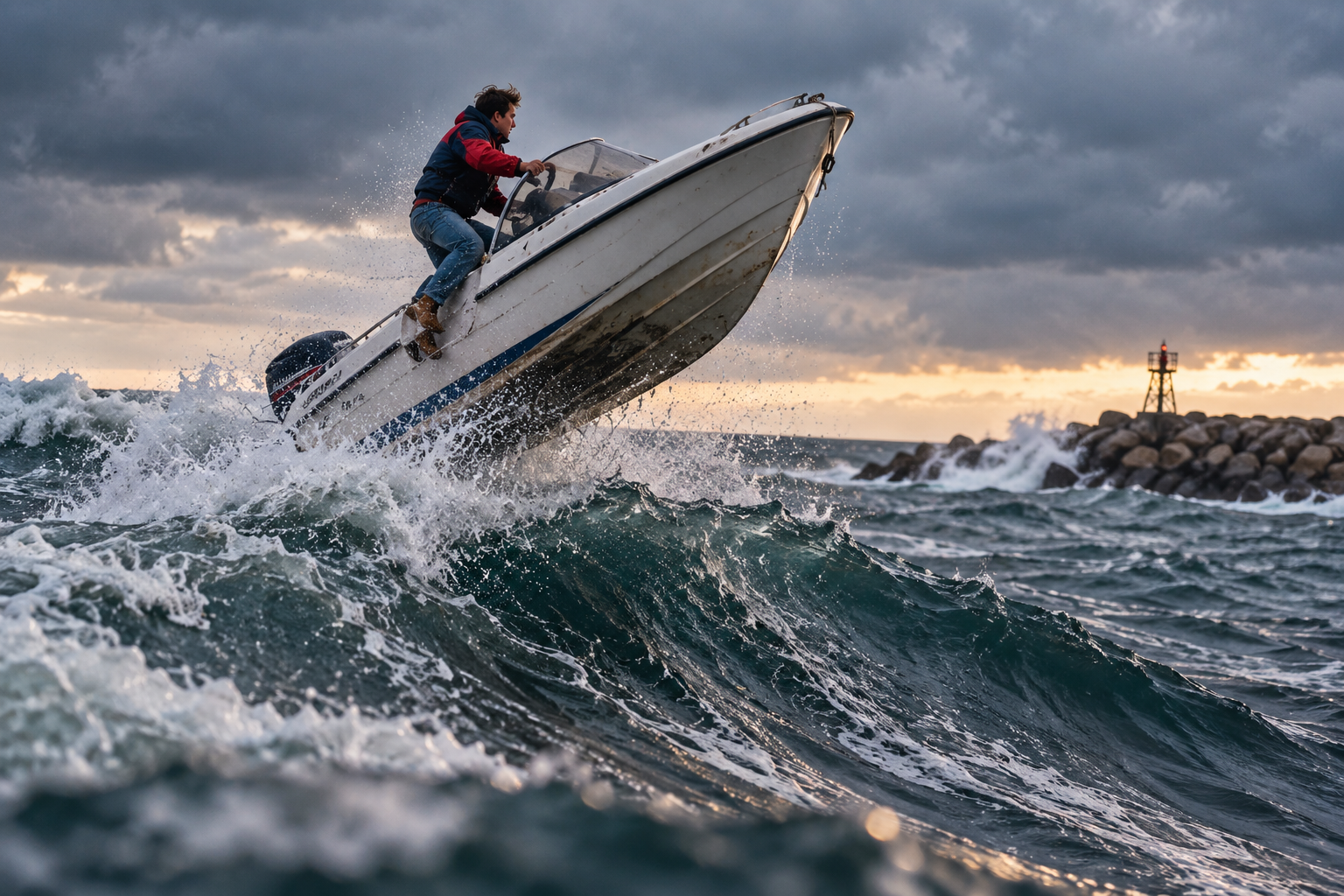
I knew there was a small-craft advisory.
I left Galilee anyway.
That’s the part of this story that still interests me.
When I was young, I did a lot of stupid things.
A lot.
One of them falls into the “things we do for love...” category.
My girlfriend was living at Salve Regina in Newport. I was at URI in Narragansett. She wanted me to grab the keys to her parents’ speedboat, basically steal the boat, and come pick her up.
That’s a lot of water between us.
And there was a major storm coming.
The sky was overcast. The ocean was rough. There was a small-craft advisory.
Still, I left Galilee.
At the gap in the Point Judith breakwall, the tide was ripping through. When big ocean swells meet fast-moving water through a narrow opening like that, they stand up dramatically.
These were enormous waves.
The bow dropped into one, started climbing the next, and I gunned it.
Then I could hear the propeller spinning wildly.
You don’t ever want to hear that.
It means your boat is out of the water.
The sound was so strange I looked back.
I was hanging onto the steering wheel, being pulled upward with it, my feet dangling below me. From crest to trough, it felt like I was hanging from a trapeze, staring off the side of a skyscraper as the boat hopped the wave.
The stern landed first, and the rest of the boat slapped down in front of it.
We rode the wave into the trough. At the bottom, the boat pitched up so violently that I crumpled like a soda can into the steering wheel, dash, and floor.
I was hurt, yes.
But there wasn’t time for hurt.
Just me screaming, “Up. Up. Get up. UP!”
I got up and somehow maneuvered the boat out of that gap.
I got lucky.
But it never had to get that far.
I knew there was an advisory. I had been taught to respect the ocean. Heck, I’d even been told not to take a boat that size outside the breakwall.
I knew.
But somehow, I didn’t know.
The storm taught me one thing the hard way: DON’T DO THAT!
And I never did it again.
What it didn’t teach me was why I’d ignored the warning in the first place.
Years later, I was still doing boyish things, like driving eighty miles an hour.
One of my patients, a firefighter, tried to get me to slow down. He was doing a kind thing.
“Doc, I see a lot of crashes. A lot. Crashes at highway speeds, around 55 to 65 mph, we’re still usually taking people to the hospital. At 80, we’re taking them more often to the morgue.”
I heard him, but I didn’t hear him, if you know what I mean.
Then I learned something about the way we process risk.
We tend to think bad outcomes happen to other people. We make ourselves the exception. And we can discount negative information we really don’t want to hear.
The warning is there.
We just don’t see ourselves in it.
And I remember thinking:
Oh.
I do that.
The firefighter wasn’t talking about somebody else.
He was talking about people doing exactly what I was doing.
That’s when I started slowing down.
Not because someone finally told me the right thing, scared me into seeing it, or explained the physics.
I finally understood what I had been doing with the information.
And once I saw it there, I started seeing it everywhere.
I used to give nutrition talks. When I got to the health consequences of alcohol, someone would almost inevitably say, “Yeah, but what about George Burns?”
If you don’t know him, he was the comedian famous for appearing with a cigar and a drink. He lived to 100.
There it was.
The exception.
Now I’m better at noticing when I’m making myself the exception or dismissing something I don’t want to hear.
I don’t make nearly as many 80-mph food choices anymore.
And I pay more attention to the choices that add up in the other direction, too.
I can actually see the choice, weigh it, and make it for myself.
Turns out, health is a consequence, too. ;-)